
UniCities: United for energy innovation
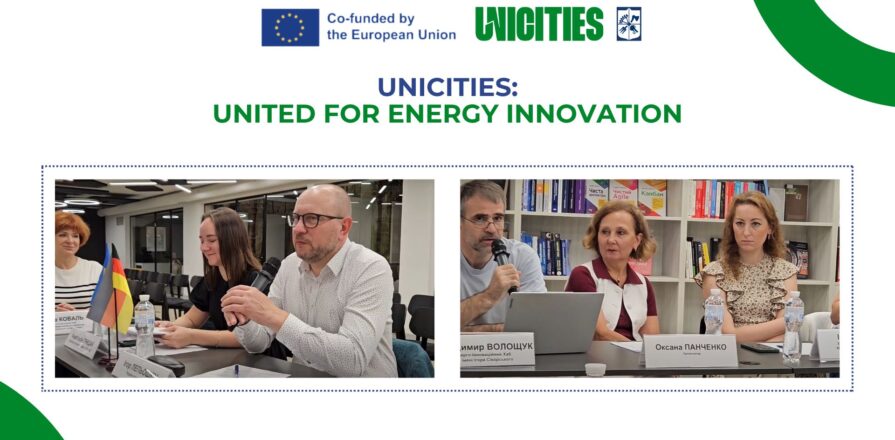
On July 3, 2025, a roundtable discussion titled “Development of the Network of Energy Innovation Hubs for Ukraine’s Recovery” was held at the H.I. Denysenko Scientific and Technical Library, hosted by the Energy Innovation Hub of Igor Sikorsky Kyiv Polytechnic Institute (KPI). The event was supported by the KPI Energy Decarbonization Center team, established within the UniCities project.
The roundtable brought together representatives of eight Energy Innovation Hubs from various regions of Ukraine, including Lutsk, Dnipro, Mykolaiv, Kharkiv, Sumy, Zaporizhzhia, Chernivtsi, and Kyiv. Participants presented the results of their work during the first half of 2025, shared experiences, discussed key challenges, and outlined further directions for the development of the network.
The main topics of discussion included strengthening cooperation with local communities, developing human resource capacity, adapting European energy management practices, and scaling up effective local initiatives to the national level. Particular attention was given to the analysis of opportunities arising from the study visit to Munich, which provided insights into implementing modern energy efficiency solutions in the Ukrainian context.
The final part of the roundtable focused on defining strategic priorities for the second half of 2025 and for 2026. Key areas identified included: expanding interregional cooperation between the Hubs, improving the quality of professional education in the field of energy innovation, intensifying project activities, and building strong partnerships.
After the official session, participants joined a guided tour of the KPI Energy Innovation Hub space, where technical solutions, educational approaches, and scientific initiatives were showcased.
The UniCities project team continues to support the transformation of higher education, the strengthening of community resilience, and the implementation of innovations in the energy sector. Events like this are a meaningful contribution to Ukraine’s recovery based on sustainable, evidence-based, and technology-driven solutions.
*Сo-funded by the European Union. Views and opinions expressed are however those of the author(s) only and do not necessarily reflect those of the European Union or the European Education and Culture Executive Agency (EACEA). Neither the European Union nor EACEA can be held responsible for them.