UniCities. Grand finale of the summer school “Shaping urban environments for tomorrow”
Where do nature-based solutions, sustainable approaches to modernizing recreation facilities, and integrating innovative approaches into local communities come together? The UniCities team is convinced that the heart of significant transformations is a community of active, educated change-makers.
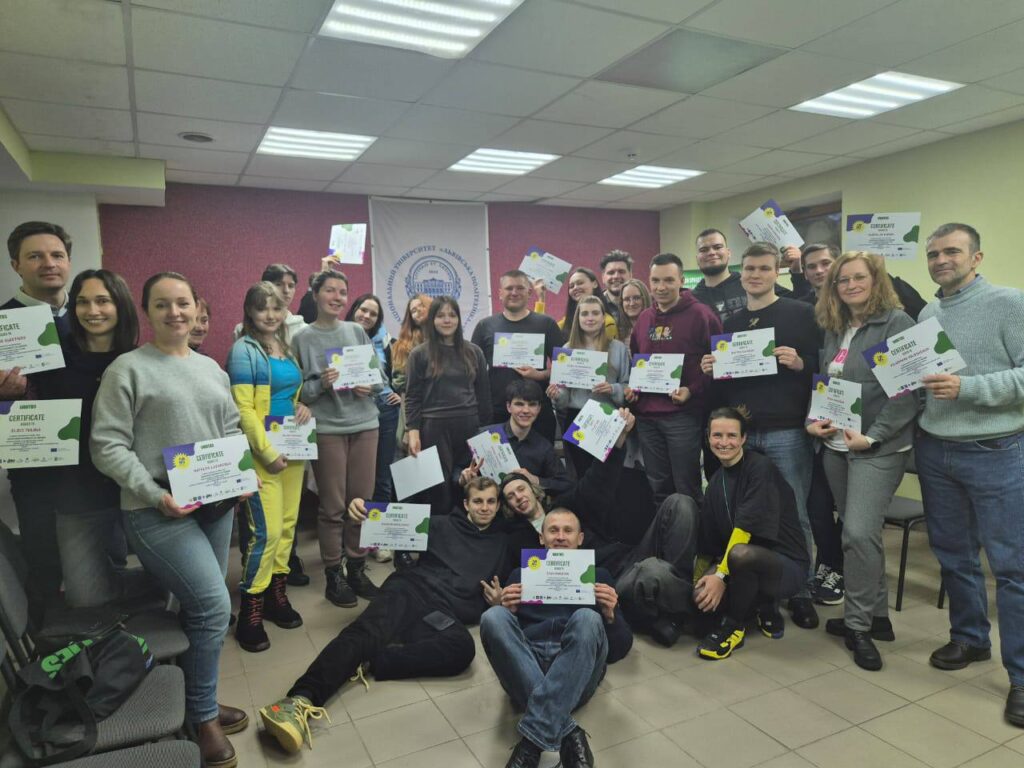
On April 11, 2025, both the presentation of the students’ summer school projects, “Shaping urban environments for tomorrow” and its grand finale took place. During the week, students explored the possibilities of sustainable development of recreational facilities in the Carpathian region. They analyzed energy consumption, water supply systems, and waste management, searched for environmentally responsible solutions for the operation of tourist centers and their integration into communities. A real case study for teamwork was the training and recreation center “Polytechnic-2”, where the summer school “Shaping urban environments for tomorrow” was held.
Renowned experts shared their experience, knowledge, and the results of their own projects:
- Olga Kordas – Associate Professor in Sustainable Urban Development at the Department of Sustainable Development, Environmental Science and Engineering (SEED), KTH Royal Institute of Technology (Stockholm, Sweden) and Director of the Viable Cities;
- Vira Balabukh – Ukrainian researcher, PhD in Geography, and Head of the Department of Applied Meteorology and Climatology at the Ukrainian Research Hydrometeorological Institute;
- Maksym Kryvosheev – head of the Ukrainian Green Building Council (UGBC), a non-governmental organization part of the global network of the World Green Building Council (WGBC);
- Jaime Moreno – PhD candidate and associate professor at the Universidad Politécnica de Madrid (UPM). He has collaborated with itdUPM, Harvard University, and Viable Cities;
- Oksana Udovyk – researcher at the ІNGENIO Institute, research center of of the Spanish National Research Counsil
- Siarhei Liubimau – Associate Professor and Lead in Laboratory of Critical Urbanism, European Humanities University (Vilnius, Lithuania).
- Oleksandr Pechenenko – architect, urban planner, specialist in the fi eld of integrated urban development and spatial planning, NGO ‘Centre for Community Cooperation and Development”.
- Olena Pitirimova – architect at Zotov&Co.
- Daryna Pyrogova – expert in strategic and spatial development of hromadas, head of NGO “U-Cycle”.
- Natalia Lazarenko – manager of the international activities of the Association of Ukrainian Cities.
Students, researchers, and experts were divided into four teams to develop unique solutions. Their ideas and developments concerned various aspects of the base’s functioning. Surveys, analysis, and other research tools were conducted.
Thus, the “Yellow Submarine” team focused on the issue of landscaping and intensified cooperation between the base and the village of Slavsko. It was proposed to use nature and culture-oriented solutions to preserve and improve the cultural landscape of the village and the base.
The “Opryshky” team focused on the complex issue of synergy of landscaping, optimization of the administrative system, and formation of visitors’ eco-consciousness. They were inspired by the topic of mimicry, which Oksana Udovyk discussed in her lecture.
The “ClimateMakers” team’s project can be considered as a logical continuation. Its participants are convinced that a climate school can be created based on Polytechnic-2, a platform for environmental education, climate change adaptation, and communication between students, scientists, and community representatives. In addition, they proposed experimental, nature-based, and digital solutions.
The goal of the “Polytechnic named after Yaroslav Mydryi” team was to develop recommendations to promote the sustainable development and financial stability of the Polytechnic-2 (P-2) camp, optimize energy consumption, and introduce new services. They can be used to expand the target audience and increase the institution’s competitiveness.
It is important to note that the base director, Volodymyr Bilodid, also attended the project presentations. He emphasized that the teams had prepared high-quality and interesting proposals that he would consider in further planning.
The summer school participants noted that teamwork was inspiring. They plan to apply the knowledge and experience gained in future projects. The UniCities team believes that education, science, and community are the keys to developing Ukrainian cities!
It is worth reminding that the project is being implemented by partner institutions: Royal Institute of Technology KTH (Sweden), Universidad Politechnica de Madrid, UPM (Spain), National Technical University of Ukraine Igor Sikorsky Kyiv Polytechnic Institute, NTUU KPI (Ukraine), Chernihiv National University of Technology, CNUT (Ukraine), Academician Yuriy Bugay International Scientific and Technical University, ISTU (Ukraine), Yaroslav Mudryi National Law University, NLUU (Ukraine), Charitable Fund CANactions, All-Ukrainian Association of Local Government Authorities “Association of Ukrainian Cities”, Public union «Association of the engineers of stable energy technologies of Ukraine», Ukrainian Research Hydrometeorological Institute, UHMI.