UniCities: Driving Global Collaboration for Climate-Neutral and Resilient Cities
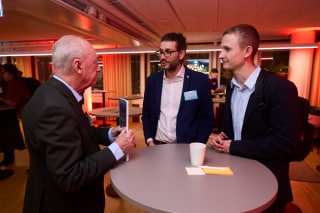
On December 5-6, 2024, the UniCities team, co-funded by the European Union through the Erasmus+ program, participated in the European Viable Cities Day and a workshop on Aggregated Purchasing Power for Climate-Neutral and Smart Cities.
These events brought together over 300 participants from across the globe, including prominent representatives such as Jessika Roswall, the newly appointed Swedish EU Commissioner for Environment, Water Resilience, and Competitive Circular Economy, and Patrick Child, Deputy Director General of DG Environment and Mission Manager for the EU Cities Mission. The gathering also included representatives from Swedish and American cities, Swedish government agencies (Vinnova, Formas – the Swedish Research Council for Sustainable Development, the Swedish National Energy Agency, the Swedish Agency for Economic and Regional Growth, the Swedish Environmental Protection Agency, and the Swedish Transport Agency), KTH Royal Institute of Technology—the coordinator of UniCities and host of Viable Cities—research institutions, international organizations, and key city initiatives such as Viable Cities, citiES2023, NetZeroCities, capaCITIES, UN-Habitat, and the Climate Finance Leadership Alliance.
Jessika Roswall, the newly appointed Swedish EU Commissioner for Environment, Water Resilience, and Competitive Circular Economy, highlighted that:
“ I’m particularly encouraged by the presence of Ukrainian representatives here today. In the face of the hardship that Ukrainian people face as a result of the war, let me reaffirm the EU’s commitment to stand by Ukraine for as long as it takes to win the war, but also to help you rebuild your cities once the war is over. I think the collaboration between Swedish and Ukrainian cities is a testament to the resilience of communities working together for a better and more sustainable future”.
The event provided an invaluable platform for exchanging ideas, discovering innovative solutions, and fostering global partnerships. Discussions focused on the transformative potential of joint purchasing power among cities as a critical tool for achieving climate neutrality. Cities and local communities collectively allocate over $3 trillion annually to procurement, presenting a significant opportunity to redirect these funds toward impactful local initiatives. However, municipal procurement processes often face challenges and typically contribute only 20% of the investment required to achieve climate neutrality. Collaborative procurement strategies offer a pathway to reducing costs, standardizing climate commitments, enhancing cooperation between public and private stakeholders, and attracting investments in sustainable and green technologies.
One compelling example of such innovation was showcased in Stockholm through a demonstration project highlighting advancements in transport electrification, clean air zones, and modernized urban infrastructure. Furthermore, the signing of the Climate City Contract 2030, which brought together mayors from 48 cities representing 50% of Sweden’s population participating in the Viable Cities platform, underscored the importance of ambitious climate goals and collaborative action.
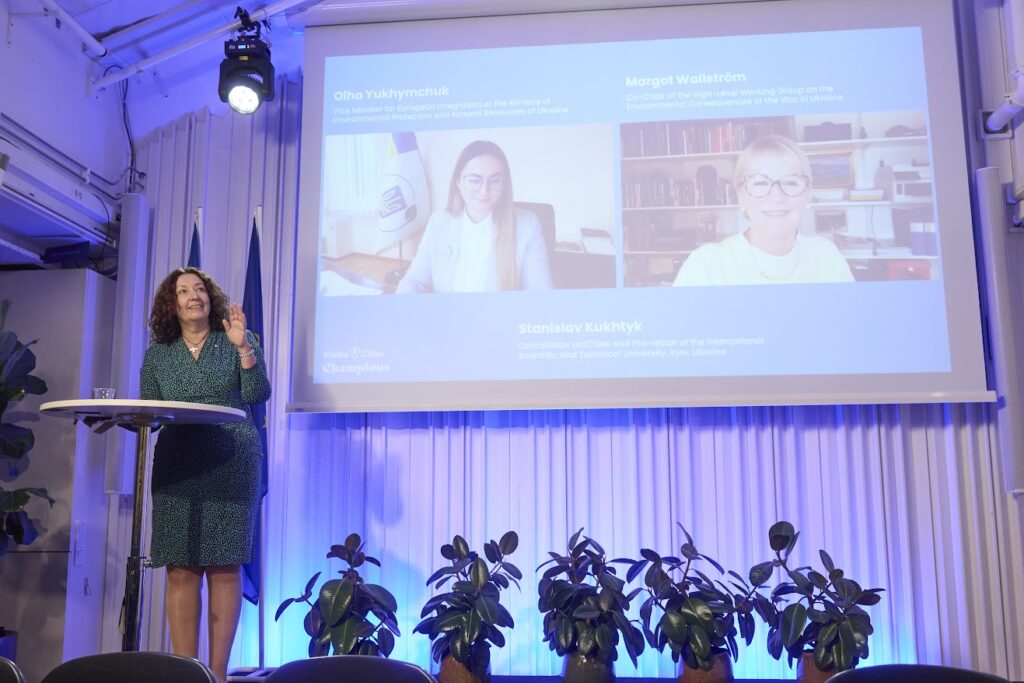
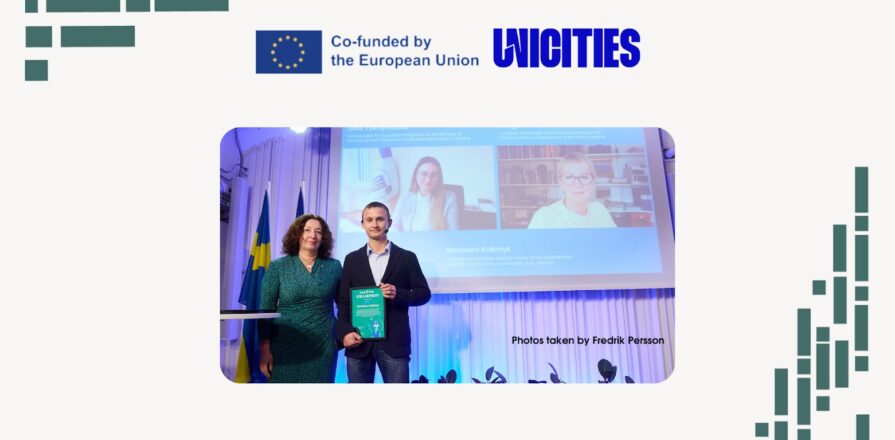
For the UniCities team, the event was a source of inspiration and a springboard for new ideas. Viable Cities, the event organizers, also recognized the pivotal role of the UniCities project in enabling Ukrainian universities to act as catalysts for systemic change and green recovery in Ukrainian cities. Each year, Viable Cities honors leaders in green transformation and climate neutrality, and this year, the awards celebrated the remarkable contributions of:
- Olga Yukhymchuk, Deputy Minister of Environmental Protection and Natural Resources of Ukraine,
- Stanislav Kukhtyk, Vice-Rector for International Relations and Development at the Academician Yuriy Bugay International Scientific and Technical University,
- Margot Wallström, Co-Chair of the High-Level Working Group on the Environmental Consequences of the War in Ukraine and former Swedish Minister of Foreign Affairs.
While accepting the award, Olga Yukhymchuk emphasized the importance of innovative platforms like Viable Cities, stating:
“We are inspired by Sweden and the work of Viable Cities. Sweden has demonstrated how universities, cities, businesses, and civil society can collaborate to drive sustainable change. I am pleased that the UniCities project, co-funded by the European Union, is helping to establish similar structures in Ukraine. This project enables our universities to play a vital role in transforming our cities sustainably.”
Olga Kordas, head of Viable Cities, echoed this sentiment:
“We have seen how the collective efforts of communities, national agencies, universities, private businesses, civil society, and experts can create real change. This inspires us to move forward, build new partnerships, and implement innovative solutions to support the green recovery and sustainable development of Ukrainian cities.”
The Ukrainian coordinator of UniCities, Stanislav Kukhtyk, highlighted the importance of international collaboration for Ukrainian universities, stating:
“I am honored to accept this award on behalf of all UniCities project partners, including Ukrainian universities, the Association of Ukrainian Cities, and NGOs. Our goal is to strengthen university-city collaboration for the green rebuilding of cities. In this, we’ve been inspired by KTH Royal Institute of Technology and the Polytechnic University of Madrid. Working with Viable Cities and Cities 2030 has been a source of energy and hope, helping us face immense challenges during the war.”
The Stockholm event served as a powerful reminder that the future of climate-neutral cities lies within our collective grasp. The UniCities team remains committed to advancing this vision, paving the way for a greener and more sustainable Ukraine.