
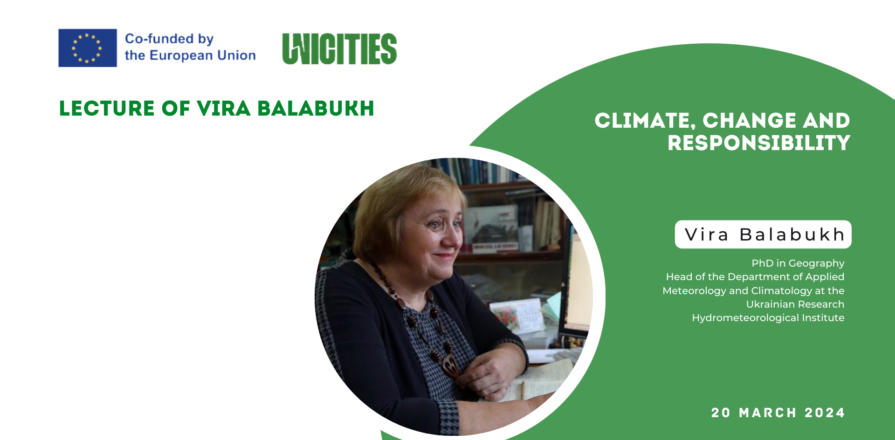
Lecture of Vira Balabukh: Climate, change and responsibility
A lecture by Vira Balabukh, a well-known Ukrainian researcher, PhD in Geography, and Head of the Department of Applied Meteorology and Climatology at the Ukrainian Research Hydrometeorological Institute, took place on 20 March 2024. The event was held as part of the “UniCities” — an Erasmus project. Students of the partner universities of the project had the opportunity to learn about relevant issues related to climate, its changes, and the impact of the consequences on people’s lives.
Vira Balabukh with over 15 years of experience in climate research, believes that environmental awareness should not be put off. The researcher notes: “By the end of the 21st century, climate change and its impact will intensify, which already requires the development of adaptation and mitigation measures and the use of new potential opportunities that are opening up”.
The lecture was opened by introducing the participants to the basic concepts, terms, and ideas related to climate and its evolution. Vira emphasizes that the climate system evolves under the influence of the internal dynamics of its components, and their interaction, as well as under the influence of external factors such as volcanic eruptions, changes in solar activity, anthropogenic changes in the atmospheric gas composition, and changes in land use as a result of economic activity. It is human activity that accelerates climate change. For example, more than 50% of the increase in the average global surface temperature observed from 1952 to 2010 was caused by an increase in anthropogenic greenhouse gas emissions and other anthropogenic factors.
Even though some politicians consider climate change to be a non-priority issue, global warming is already happening. Vira Balabukh points out that since 1950, many of the recorded changes in the climate system are atypical or unprecedented in recent decades or even millennia. Currently, the most likely changes are observed in the non-tropical latitudes of the Northern Hemisphere.
It is important to note that Ukraine is also one of the regions that most clearly reflects the changes. For example, rising air temperatures and uneven distribution of precipitation have already led to an increase in the number and intensity of drought events. Combined with other anthropogenic factors, this is leading to catastrophic consequences. The Russian Federation’s aggression against Ukraine and occupation of its territories only exacerbates these trends.
Vira Balabukh is convinced that to overcome the serious challenges facing the world, national strategies must be implemented. Education should play a significant role in this. Comprehensive strategies for the education sector should be developed to build climate-smart and sustainable education systems. Only educated and conscious citizens can change their cities and the world for the better!