
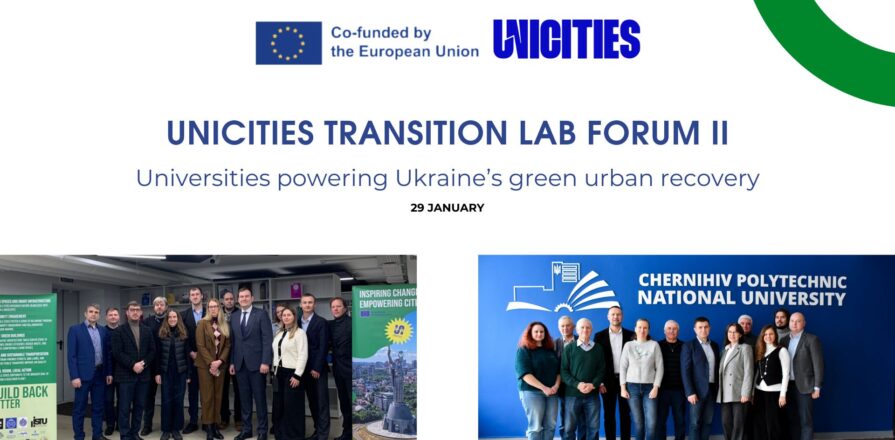
UniCities Transition Lab Forum II – Universities powering Ukraine’s green urban recovery
On 29 January 2026, the UniCities Transition Lab Forum II – Universities powering Ukraine’s green urban recovery brought together universities, cities, policymakers, researchers, practitioners, and students to reflect on how Ukraine’s recovery can be shaped through climate-neutral and sustainable urban development.
The Forum was organised within the UniCities institutional cooperation project, co-funded by the European Union under the Erasmus+ Programme, and held in a hybrid format. Participants joined both on-site and online, connected through a live tele-bridge linking Stockholm, Kyiv (KPI), and Chernihiv (CPNU). This format ensured broad accessibility while clearly reflecting the European and international nature of the UniCities partnership.
The opening session focused on the EU Cities Mission and the impact and outcomes of the UniCities. Olga Kordas (Viable Cities, KTH), coordinator of the project, reflected on mission-oriented innovation and long-term city–university partnerships across Europe. While, Stanislav Kukhtyk, Vice-Rector of ISTU and Ukrainian coordinator of UniCities, together with Jaime Moreno (Technical University of Madrid, citiES2030), highlighted how UniCities is strengthening Ukrainian universities as active actors in urban transformation.
Academic and municipal perspectives were further enriched by Dmytro Boichuk (Yaroslav Mudryi National Law University) and representatives of Kharkiv City Council — Yurii Diachenko and Yana Moskalenko — who shared insights into municipal governance and energy management. The broader European policy framework was addressed by Laura Hetel from the European Commission (DG RTD), while Pavlo Kartashov, Deputy Minister of Economy, Environment and Agriculture of Ukraine, emphasised the role of energy transition in urban recovery.
The discussion then moved to the role of universities as enablers of sustainable urban transition. University leaders and researchers — Veronika Khudolei (ISTU), Andrii Shysholin (Kyiv Polytechnic Institute), Mikael E. Lindström (KTH), and Teresa Sánchez (UPM) — explored how education, research, and international cooperation can directly support cities in addressing climate, energy, and resilience challenges. Their perspectives were complemented by applied, city-facing expertise from Serhii Pavlovskyi, Director of the Municipal Research Institute “City Development Institute,” who spoke from the standpoint of urban development practice and evidence-informed planning. City-level experiences from Juan Azcárate (Madrid City Council) and Annika Jacobson (City of Stockholm) further demonstrated how collaboration between universities and municipalities translates into practical urban solutions.
A dedicated session on building capacity for recovery, resilience, and climate transition brought the discussion closer to implementation. Oleksandr Slobozhan and Nataliya Lazarenko from the Association of Ukrainian Cities addressed the needs of local governments across the country. Practical insights were shared by Olena Pitirimova (CANactions) and Anastasiia Bratkova (RSE), focusing on urban planning, stakeholder engagement, and private business investments. The perspective of the younger generation was represented by Anastasiia Soroka, a student at Chernihiv Polytechnic National University, who highlighted the role of students in shaping future urban policies.
The Forum further emphasised the importance of strengthening collaboration for a thriving Ukraine. Svitlana Shytikova, Director of the National Erasmus+ Office in Ukraine reflected on how Erasmus+ projects contribute to long-term institutional capacity and European integration.
Cristina Robledano (UPM) addressed the role of climate philanthropy, while representatives of Chernihiv Polytechnic National University — Serhiy Schkarlet and Anatoliy Prystupa — together with Nataliia Holchenkova from Chernihiv City Council, shared experience on translating international cooperation into local development strategies. Olga Kordas concluded the session by linking these discussions back to the broader UniCities vision.
The final part of the Forum focused on synergy perspectives with other green transition and climate neutrality initiatives in Ukraine. Alongside the UniCities project team, Tetiana Melnyk (SUN4Ukraine), Stefan Zaychenko (U_CAN), Ihor Leposhkin (GIZ), and Anastasiia Skok (BDO Ukraine) discussed opportunities for coordination, complementarity, and scaling impact beyond individual projects.
The UniCities Transition Lab Forum II served as a space for dialogue, learning, and forward-looking cooperation. The discussions reaffirmed that universities are not only centres of knowledge, but strategic partners capable of connecting European priorities with local needs and supporting Ukraine’s pathway towards climate-neutral, resilient, and sustainable cities.
The Forum recording is available at the following link:
Co-funded by the European Union. Views and opinions expressed are those of the authors only and do not necessarily reflect those of the European Union or the European Education and Culture Executive Agency (EACEA).